Wind energy
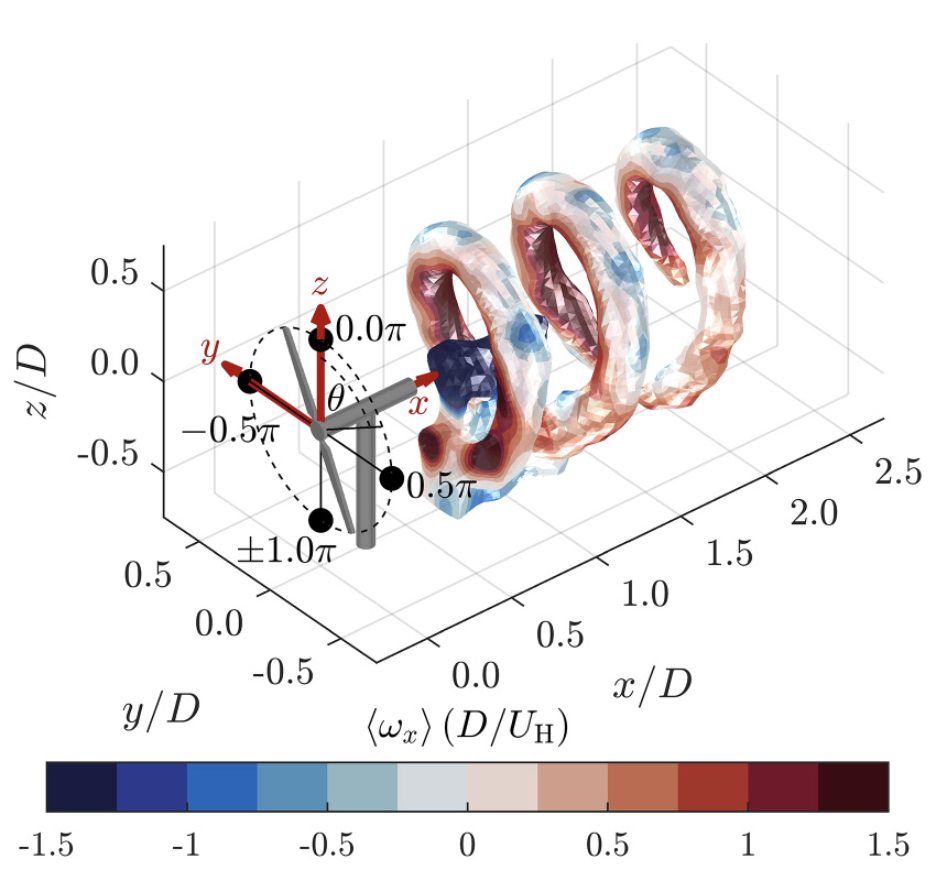
A personally fulfilling project at NTNU has been regarding wind energy. In this project, we are looking into the effects of atmospheric turbulence on the flow features downstream of a wind turbine. The aim was to recreate the conditions faced by wind turbines in a wind farm settings in a laboratory environment. Active turbulence grids were used to generate such conditions. In order to obtain a full picture of the flow dynamics, we acquired time-resolved, three dimensional data using a particle tracking velocimetry setup.
One of the first and significant findings of this project concerns wing-tip vortices. When spectra is computed on fluctuations in the turbine’s wake, a peak is often observed at the rotor frequency rather than the blade-pass frequency (number of blades * rotor frequency) in previous research efforts. Our volumetric measured helped us unearth a potential cause of this peculiar observation. Due to small deformations in the two blades of the used model turbine, one of the tip vortices was stronger than the other, which lead to the vortices merging just downstream of the turbine. This vanishing vortex is the reason for is the reason behind the missing spectral peak at the blade-pass frequency. Any irregularities in the turbine’s geometry due to manufacturing tolerances or wear could potentially lead to such a situation. This result was published as a Letter in Physical Review Fluids*.
*Physical Review Fluids (2024)
Hydrogen combustion

Combustion was a field I worked on at NTNU. One of the main activities I was part of was to commission a green-laser based particle image velocimetry (PIV) system in the combustion lab in order to obtain quantitative data of the flow field in and around the flame. We not only completed this task successfully, but also incorporated a stereoscopic PIV system and synchronised it with a UV-laser based PLIF system to visualise the same slice of the flow and flame. This one of a kind system has helped several researchers in the lab with their specific projects. You can look at this post to see the setup in action.
I also took part in a project on suppression of self-exited thermoacoustic instabilities in Hydrogen flames which can be pivotal in Hydrogen-based gas turbines in the future. This was achieved using the lock-in phenomenon between the acoustic mode and vortex shedding from cylinders placed upstream. This system produces a destructive interference, leading to the suppression of self-excited combustion instabilities. This work was presented in the 39th International Symposium on Combustion and subsequently published in the Proceedings of the Combustion Institute*. It was also conferred one of the 2023 Distinguished Paper Award in Propulsion at the symposium.
*Proceedings of the Combustion Institute (2023)
Aircraft swept-wing transition control & drag reduction
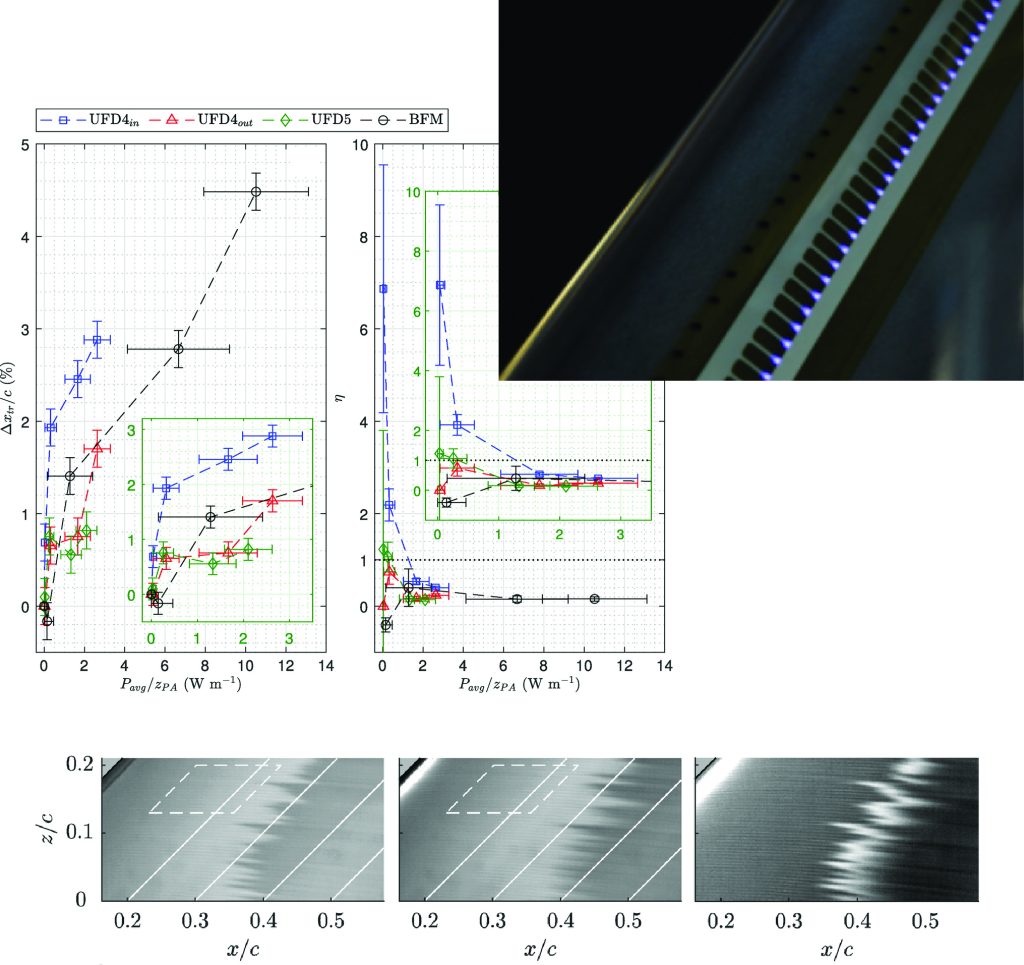
During the time I spent at TU Delft, The Netherlands, I worked on aircraft swept-wing boundary layers. The aim was to control crossflow instabilities prevalent in this boundary layer using plasma actuators with the ultimate goal being to delay transition to turbulence and achieve drag reduction.
Using the automated fabrication process that we envisaged we produced extremely thin electrodes at the micron scale. These actuators were capable of exerting 2D and 3D forcing. The latter is is shown in the image of the plasma discharge on the wing model.
We conceived a number of new plasma actuator designs and tested several control strategies experimentally. We employed particle image velocimetry to gather quantitative data of the flow and infrared thermography as a primary tool to visualise the movement of the transition front. This is depicted the row of back-and-white images, with the last one being the subtraction of the first two, indicating a delay in transition.
By enhancing the plasma-actuator fabrication process and exploring novel designs we demonstrated a delay in transition to turbulence and achieved drag reduction as well. I wrote a magazine article telling the story of how this research conceptualised and developed. The scientific discussions pertaining to these efforts can be found in our various peer reviewed journal articles*.
*AIAA Journal (2021) | Journal of Fluid Mechanics (2017, 2018)
Free shear layers
Free shear layers was a flow configuration I researched upon during my research stay at Institut PPrime, University of Poitiers, France. Shear layers, the Kelvin-Helmholtz instability and vortices that are prevalent in this flow configuration are a common occurrence in fluid mechanics. The motivation of this project was to obtain fundamental insights into the control exercised by plasma actuators on fluid flows.
As a first step, I actively participated in modifying an existing wind tunnel to make it suitable for shear layer studies. Particle image velocimetry at a very high sampling rate was employed to quantify the flow dynamics. I used a combination of proper orthogonal decomposition, stability analysis, vortex identification schemes and phase averaging to ascertain the effect of plasma forcing on this very fundamental flow configuration.
Working on this topic gave me a more fundamental understanding of fluid mechanical systems. I also developed skills to generate code packages for large data analysis. Some of this work is discussed in one of our peer-reviewed journal article*.
*Physics of Fluid (2020)
Plasma-based flow control
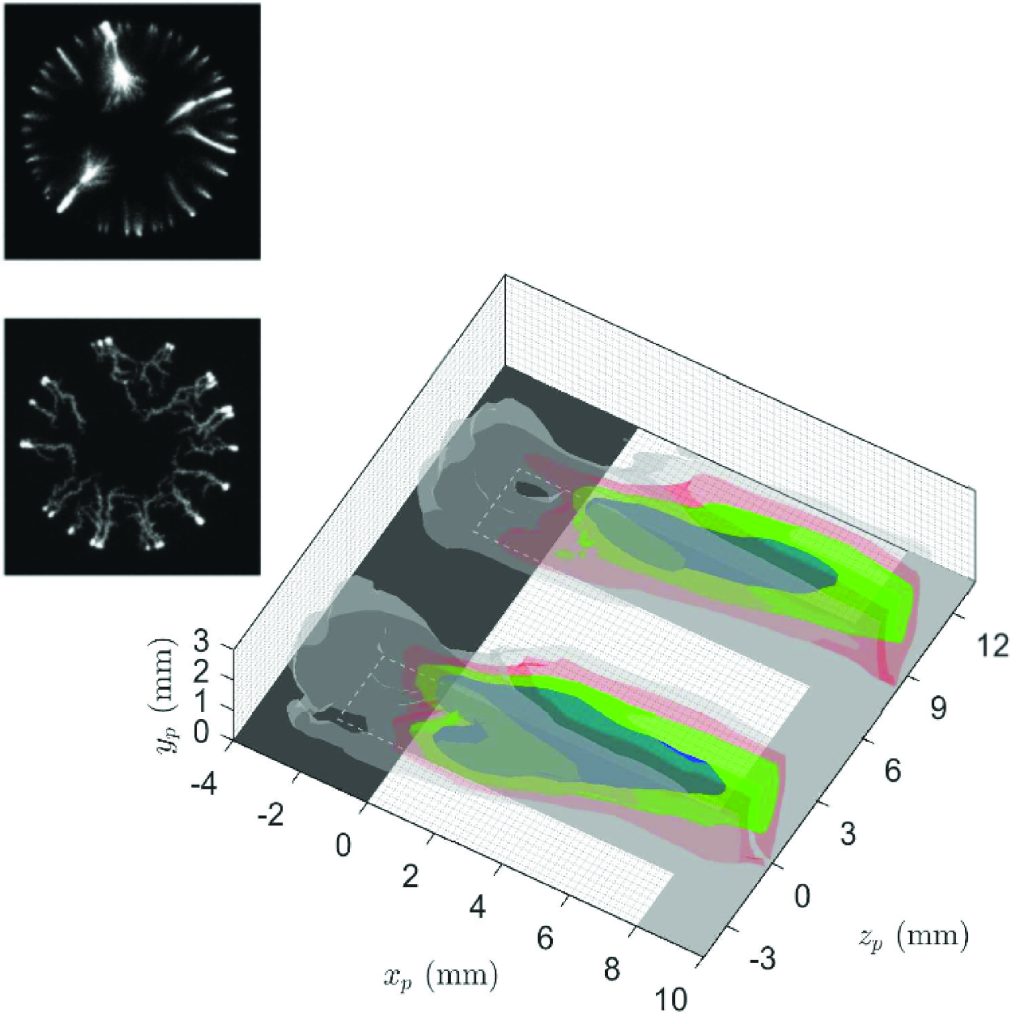
Plasma-based flow control using dielectric barrier discharge (DBD) actuators has been a significant theme in my research efforts. I carried out research with some of the top experts in this field and in labs highly renowned for this topic. My PhD dissertation was aptly named Plasma-flow interfaces for instability control.
My research in this area necessitated the use of DBD actuators with complex geometries which can allow us to exert 3D forcing on air flows. In order to achieve this, I formulated a novel fabrication technique. This involved employing a CNC machine with a laser head to generate a mask with the shape of the necessary electrodes. Silver particles are then sprayed on to the dielectric to produce the electrode. With this technique, I produced electrodes that were only tens of micron in thickness.
In the process of this research, I gained much experience in using high-voltage electrical devices, high precision signal generators and oscilloscopes. Through ICCD imaging, I looked into the paths that charged particles took in the electric field and the structure of the generated plasma. I also employed tomographic velocimetry in quiescent conditions to obtain quantitative data of the three-dimensional flow velocity induced by the plasma actuators I designed and fabricated. This enabled me to exercise flow control and achieve the goals of several research projects.
My scientific contributions
Peer-reviewed journal articles
- Hillestad, J.N., Yadala, S., Neunaber, I., Li, L., Hearst, R.J., Worth, N.A. (2024). Volumetric visualisation of vanishing vortices in wind turbine wakes. Physical Review Fluids 9(5), L052701. | View & Download |
- Æsøy, E., Jankee, G. K., Yadala, S., Worth, N. A., & Dawson, J. R. (2023). Suppression of self-excited thermoacoustic instabilities by convective-acoustic interference. Proceedings of the Combustion Institute, 39(4), 4611-4620. | View & Download | This article was conferred the coveted 2023 Distinguished Paper Award in Propulsion by The Combustion Institute.
- Yadala, S., Hehner, M. T., Serpieri, J., Benard, N., & Kotsonis, M. (2021). Plasma-based forcing strategies for control of crossflow instabilities. AIAA Journal, 59(9), 3406-3416. | View & Download |
- Yadala, S. (2020). Plasma-flow interfaces for instability control. University of Poitiers, Doctoral dissertation. | View & Download |
- Yadala, S., Benard, N., Kotsonis, M., & Moreau, E. (2020). Effect of dielectric barrier discharge plasma actuators on vortical structures in a mixing layer. Physics of Fluids, 32(12). | View & Download | Download |
- Yadala, S., Hehner, M. T., Serpieri, J., Benard, N., Dörr, P. C., Kloker, M. J., & Kotsonis, M. (2018). Experimental control of swept-wing transition through base-flow modification by plasma actuators. Journal of Fluid Mechanics, 844, R2. | View & Download | Download |
- Serpieri, J., Venkata, S. Y., & Kotsonis, M. (2017). Conditioning of cross-flow instability modes using dielectric barrier discharge plasma actuators. Journal of Fluid Mechanics, 833, 165-205. | View & Download | Download |
Conference proceedings
- Fridlender, T., Yadala Venkata, S., Benard, N., & Moreau, E. (2023). Electrical characteristics and flow topology of ring-type dielectric barrier discharge plasma actuator. In AIAA Scitech 2023 Forum (p. 2389). | View |
- Yadala, S., Jankee, G. K., Æsøy, E., Dawson, J. R., & Worth, N. A. Influence of a cylinder installed upstream on the flow field of a turbulent jet. In 12th International Symposium on Turbulence and Shear Flow Phenomena, TSFP. | View & Download |
- Jankee, G. K., Yadala, S., Æsøy, E., Dawson, J. R., & Worth, N. A. Data-driven model for vortex lock-in of circular cylinders in an acoustically-driven oscillatory flow. In 12th International Symposium on Turbulence and Shear Flow Phenomena, TSFP. | View & Download |
- Yadala Venkata, S., Benard, N., Kotsonis, M., & Moreau, E. (2020). Effect of DBD plasma actuation on structures in a plane mixing layer. In AIAA Scitech 2020 Forum (p. 2152). | View | Download |
- Yadala, S., Benard, N., Kotsonis, M., Kerherve, F., Moreau, E. (2019). Effect of DBD plasma actuators on vortical structures in a turbulent mixing layer. In 11th International Symposium on Turbulence and Shear Flow Phenomena, TSFP. | View & Download |
- Yadala Venkata, S., Hehner, M., Serpieri, J., Benard, N., & Kotsonis, M. (2018). Swept-wing transition control using AC-DBD plasma actuators. In AIAA 2018 Flow Control Conference (p. 3215). | View | Download |
- Serpieri, J., Yadala Venkata, S., & Kotsonis, M. (2017). Towards laminar flow control on swept wings with AC-DBD plasma actuators as active roughness. In 55th AIAA Aerospace Sciences Meeting (p. 1459). | View |